- They are born with one eye, and then grow two more
- They have been taken into outer space
- They can tolerate salinity of up to 250 g/L (around the same as that of the Dead Sea)
- They breathe through their 11 pairs of feet
- Mating can last for days at a time
- Females can reproduce asexually (a phenomenon known as parthenogenesis)
- Even more interestingly, it is meiotic parthenogenesis, the only form of asexual reproduction that permits the continuous production of advantageous combinations of genes
- If a pregnant Sea-Monkey dies with viable ovoviviparous eggs (where eggs hatch inside the mother) the embryo Sea-Monkeys will still continue to develop until they are born alive (a rare phenomenon known as necroviviparity
- Male Sea Monkeys don't have testicles
- A group of Sea-Monkeys is called a "squall.
Showing posts with label Animals. Show all posts
Showing posts with label Animals. Show all posts
Monday, 24 September 2012
The Sea Monkey Diaries: Day Seven
10 good reasons why Sea Monkeys are worthy of the Wunderkammer:

Thursday, 20 September 2012
The Sea Monkey Diaries: Day Three
Danny and I are now the proud parents of at least two baby Sea Monkeys! They're so ridiculously small that I missed my 8am meeting desperately trying to differentiate 'offspring' from 'food'.

Anyway, given that it's almost certainly the closest either of us will ever get to fatherhood, we're celebrating (with cheap Pinot and canned cassoulet!)
More photos to come. Ha! Finally a chance to take my revenge on all the ultrasound scans and goggle-eyed baby pics my breeder friends have subjected me to over the years :-p
Wednesday, 19 September 2012
The Sea Monkey Diaries: Day Two

Well, yesterday's packet-ripping action was a hard act to follow, but I actually think today's Sea Monkey fun was even more exciting...
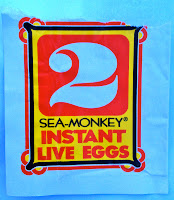
To recap, we have "founded the colony" and purified the water to create a happy home for our new pets. Today we get to add the sachet labelled "Instant Live Eggs".
"Instant Live Eggs" AKA "Brine Shrimp Cysts"
Sea Monkey engineer Harold von Braunhunt was never one to shun an attractive euphemism. And who could blame him - even the least entrepreneurial among us would appreciate that you're far less likely to sell a schoolboy a packet of "Brine Shrimp Cysts" than "Instant Live Eggs"!



Brine shrimps are one of the few invertebrates able to enter a state of suspended animation in which the metabolic processes of the cell are slowed down and the cell ceases all activities like feeding and locomotion. This process - called encystment - enables the shrimp to survive for long periods in unfavourable environmental conditions, such as when its salt pan homes completely dry out. When the encysted shrimp finds itself back in a happy place, the cyst wall breaks down by a process known as excystation.
Coming up...
We now have three or four nail-biting days where we can't do much more than sit back and wait as our brave new world unfolds. Keep following, folks!
Monday, 17 September 2012
The Sea Monkey Diaries: Day One

Yesterday, Danny found an unopened Sea Monkey set I gave him last christmas. To be honest, I think it got forgotten in the excitement of snorkeling among far larger sea-beasts of the Poor Knights Islands. Anyway, whatever the reason, we decided the time had come to awaken our sleeping Sea Monkeys...

What the #@$& are Sea Monkeys?
Well, for a start they're not monkeys. Which is rather obvious, but still highly disappointing. They're also in no way marine. Which makes the whole Sea Monkey thing something of a sham. Yet they've been a popular toy for kids (of all ages) since the 1950s and no-one really seems to mind that they're actually a rather grotesque and practically microscopic shrimp that spends the entirety of its brief existence swimming around in extremely salty puddles!
 |
| Brine shrimp (Artemia monica) from Mono Lake ©djpmapleferryman |
The scientific name for the Sea Monkey is Artemia nyos. The nyos part is an acronym of New York Ocean Science. You see, Sea Monkeys are not only a registered trademark - they're a completely artificial breed! They were created by American Harold von Braunhut in 1957, in the middle of a nationwide craze for ant farms.

Day One: Creating A Happy Home
Like great big kids with god-complexes, we set about bringing our little underwater kingdom to life. Day one is spent "colony building", i.e filling the tank with tepid water, and adding the 'water purifier' (which actually includes Sea Monkey eggs and food too). Tomorrow, we add the "Instant Life Eggs". I'm almost too excited to sleep!
If you just can't wait for the next installment, you can spoil the surprise by visiting the Official Sea Monkey Website.
Tuesday, 11 September 2012
In a word: Hibernaculum
hi·ber·nac·u·lum
[hahy-ber-nak-yuh-luhm] noun, plural hi·ber·nac·u·la [-luh]
1. a protective case or covering, especially for winter, as of an animal or a plant bud.
2. winter quarters, as of a hibernating animal.
 |
| A snake hibernaculum in London via www.wired.com |
I've often wished I were a hibernating creature. OK, never a snake to be fair. But certainly a bear or a beaver or some beast that can justifiably hide away and sleep for three or four months every year. I have even planned my perfect hibernaculum. It would be womb-like and well-stocked with midnight snacks. At the centre would be a vast bed; a cozy sea of cushions and pillows and blankets. It would have elements of a Bedouin tent or a yurt. There would certainly be lanterns; each emitting a warm, red light. But only when I wanted. You see, despite the hibernaculum's superficial primitiveness it would, of course, be magically-programmed to respond to my every need.
Once enveloped in the carefree embrace of this nest, the outside world would effectively cease to exist. Lotophagus-like, I would slumber in blissful ignorance until such time as I was bored. Then I would throw the windows of my hibernaculum open, and let in the sounds and smells of spring.
Yes yes, hardly the true ursine experience. And I should probably never try heroin...
Yes yes, hardly the true ursine experience. And I should probably never try heroin...
 |
| A bear emerging from its hibernaculum via http://rinklyrimes.blogspot.co.nz/ |
Anyway, escapist fantasies aside, for many creatures enforced hibernation is the only way to see out the winter. And more often than not, it is a far from solitary experience. Take the red-sided garter snake, which hibernates in a great seething ball. One colony, in Manitoba, is estimated to be 30,000-strong!
At the other end of the cuteness scale, Alpine marmots spend up to nine months in hibernation. That's too much time in bed even for me!
Anyway, all this talk of hibernacula is making me sleepy...
 |
| ©Olivier Blaise |
 |
| Via thelocal.de |
Anyway, all this talk of hibernacula is making me sleepy...
Tuesday, 4 September 2012
Aye-aye
According to local legends, the aye-aye is a demon that can kill just by pointing a finger. That fact alone makes it a worthy addition to the Wunderkammer. However, the aye-aye's more prosaic characteristics are equally fascinating...
Like much of Madagascar's flora and fauna, it is found nowhere else on Earth. They are the largest nocturnal primate in the world. Although it is classified as a lemur, it has continually-growing incisors like rodents and uses bat-like echolocation to find its prey. It occupies the ecological niche elsewhere filled by woodpeckers (of which there are none in Madagascar) and, most remarkably of all, hangs upside down to have sex!
The thriving folklore around the aye-eye is also one of the main reasons its numbers are in steady decline. In 1933 scientists thought it was extinct, but it was rediscovered in 1957. Unfortunately, many Malagasy still continue to persecute them, not only because of deep-seated superstitions but because they supplement their diet of grubs with farmers' fruit and veg. Also, as is the case in much of the tropics, Madagascar's forests are being felled at an alarming rate.
I have naturalist Gerald Durrell to thank for first introducing me to the aye-aye. During his later life, he was instrumental in aye-aye conservation, setting up an important captive breeding population and working with the Malagasy government and people to ensure a future for this most curious creature of the night.
Find out more about the aye-aye and how you can help:
 |
| Close-up of baby Aye-aye via Factzoo.com |
 |
| © Natural History Museum, London |
Its fabled "fingers of doom" are actually sophisticated tools which, like some arboreal Gagool, the aye-aye methodically taps tree trunks to seek out grubs. This great video from National Geographic shows the aye-aye in action..
The thriving folklore around the aye-eye is also one of the main reasons its numbers are in steady decline. In 1933 scientists thought it was extinct, but it was rediscovered in 1957. Unfortunately, many Malagasy still continue to persecute them, not only because of deep-seated superstitions but because they supplement their diet of grubs with farmers' fruit and veg. Also, as is the case in much of the tropics, Madagascar's forests are being felled at an alarming rate.
I have naturalist Gerald Durrell to thank for first introducing me to the aye-aye. During his later life, he was instrumental in aye-aye conservation, setting up an important captive breeding population and working with the Malagasy government and people to ensure a future for this most curious creature of the night.
Find out more about the aye-aye and how you can help:
- Durrell Wildlife Conservation Trust
- Madagascar Fauna Group/Save The Lemur
- Edge Of Existence
- Conservation International
Saturday, 1 September 2012
Passenger pigeon
In the 1870s, the passenger pigeon was one of the commonest birds in the world. By 1 September 1914, it was extinct.
You might well ask how could this happen. The answer, as it so often is with these things, is us. In very simple terms, we killed and ate them into extinction. Of course, there is usually more than one contributing factor to an extinction. In the passenger pigeon's case, habitat loss also played its part. But it would be fair to say that human greed in one form or another was entirely responsible for the complete annihilation of a most extraordinary bird.
Extraordinary, you say? But it's just a pigeon. A rather pretty pigeon, if Audubon's illustration is anything to go by (which, of course it is), but still a pigeon.
In fact, the incredible thing about the passenger pigeon was not its appearance. It was the mind-boggling numbers it flocked in. One report from Canada in 1866 described a flock of pigeons one mile wide, 300 miles long, and taking 14 hours to pass a single point. The estimated number of birds in this one flock was 3.5 BILLION!
With numbers like that, you can excuse a hungry pioneer bagging a few birds for the pot. But humans don't like to do things by halves. We have a singular inability to take just what we need. By the mid-1800s, there was a lucrative commercial pigeon meat industry up and running, with millions of birds being killed and processed every year. According to Wikipedia, slaves and servants in 18th and 19th century America often saw no other meat. In 1878 at Petoskey, Michigan, 50,000 birds were killed each day for nearly five months.
This grotesque industry continued until the mid 1890s, by which time the passenger pigeon had all but disappeared. Various conservation attempts and closed seasons failed. Too late, zoologists realised the birds could not breed successfully in smaller groups - they were so gregarious that they needed to be in huge flocks to initiate courtship and mating.
On this day, 98 years ago, the last known Passenger Pigeon, died in Cincinnati Zoo. Her name was Martha (after America's first First Lady). Her body was frozen into a block of ice and sent to the Smithsonian Institution, where it was skinned, dissected, photographed and mounted. An inglorious end to a species that once dominated the skies of the eastern USA.
Of course, the story of the passenger pigeon is a very familiar one, not least here in New Zealand where over 50% of native bird species have gone extinct since human settlement. Whether it was the giant, flightless moa, eaten into extinction by Polynesian settlers, or the hauntingly-voiced huia hunted out of existence because an English king 20,000 miles away once wore its tail feather in his hat, humans have had an unbelievably devastating impact on our fellow creatures and the places they live.
What is, perhaps, most remarkable about all this is that we have hunted a five billion-strong species into oblivion in a matter of decades and still haven't learned from our mistake! Ever ashamed to be human?
Find out more about the passenger pigeon here:
Help to make sure this doesn't happen again here:
 |
| J.G. Hubbard, 1898 via Wisconsin Historical Society |
 |
| John Audubon, 1824 |
In fact, the incredible thing about the passenger pigeon was not its appearance. It was the mind-boggling numbers it flocked in. One report from Canada in 1866 described a flock of pigeons one mile wide, 300 miles long, and taking 14 hours to pass a single point. The estimated number of birds in this one flock was 3.5 BILLION!
 |
| A shooting party |

With numbers like that, you can excuse a hungry pioneer bagging a few birds for the pot. But humans don't like to do things by halves. We have a singular inability to take just what we need. By the mid-1800s, there was a lucrative commercial pigeon meat industry up and running, with millions of birds being killed and processed every year. According to Wikipedia, slaves and servants in 18th and 19th century America often saw no other meat. In 1878 at Petoskey, Michigan, 50,000 birds were killed each day for nearly five months.
 |
| H. T. Phillips' Store, a typical game store of the 1870s by William Butts Mershon |
 |
| Martha, the last ever passenger pigeon via http://godwin.bobanna.com |
Of course, the story of the passenger pigeon is a very familiar one, not least here in New Zealand where over 50% of native bird species have gone extinct since human settlement. Whether it was the giant, flightless moa, eaten into extinction by Polynesian settlers, or the hauntingly-voiced huia hunted out of existence because an English king 20,000 miles away once wore its tail feather in his hat, humans have had an unbelievably devastating impact on our fellow creatures and the places they live.
What is, perhaps, most remarkable about all this is that we have hunted a five billion-strong species into oblivion in a matter of decades and still haven't learned from our mistake! Ever ashamed to be human?
Find out more about the passenger pigeon here:
- en.wikipedia.org/wiki/Passenger_Pigeon
- www.si.edu/encyclopedia_Si/nmnh/passpig.htm
- www.eco-action.org/dt/pigeon.html
- www.wbu.com/chipperwoods/photos/passpigeon.htm
Help to make sure this doesn't happen again here:
Monday, 13 August 2012
Killer cone snail
I'm probably tempting fate by posting this three days before I jet off to Rarotonga for a snorkeling holiday, but I just read a fascinating feature in the National Geographic on Dangerous and Deadly Sea Creatures, which include the beautiful and benign-looking textile cone snail.
You would never guess to look at it, but it is one of the most venomous creatures on Earth. In fact, according to Wikipedia, it was even used as a murder weapon in an episode of Hawaii Five-O! You see, like all cone snail species, it is equipped with a battery of toxic harpoon-like teeth propelled from an extendable proboscis. These can fire in any direction, even backwards, and easily penetrate gloves or wetsuits.
When it comes to the poison department, these shellfish mean business. Another name for particularly pretty geography cone of the Indo-Pacific is the "cigarette shell". And not because it's white and brown. Get yourself harpooned by this little four-incher, and you'll only live long enough to smoke a cigarette. Given that there's not even an antidote, I'd probably want something a bit stronger than a cigarette!
The secret to staying safe is apparently to not pick them up (or piss off the wrong Hawaiian!) So I'll be quashing my magpie instinct when I'm out on the reef, and enjoy these beauties from a safe distance.
Here are some more killer cones...


 |
| Conus textilus © De Agostini/Getty Images |
When it comes to the poison department, these shellfish mean business. Another name for particularly pretty geography cone of the Indo-Pacific is the "cigarette shell". And not because it's white and brown. Get yourself harpooned by this little four-incher, and you'll only live long enough to smoke a cigarette. Given that there's not even an antidote, I'd probably want something a bit stronger than a cigarette!
 |
| Conus geographus © Didier Descouens |
Here are some more killer cones...


 |
| From top to bottom: striated cone, vexillium cone and marble cone |
Subscribe to:
Posts (Atom)